
The Hidden Cost Of High Achivement
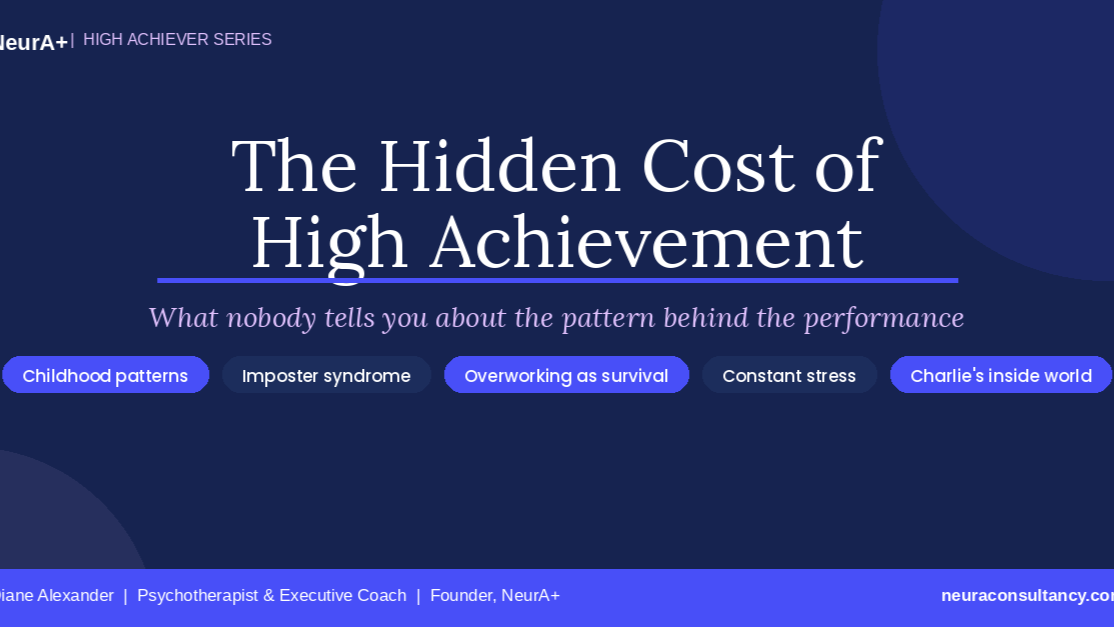
I want to talk about something that does not get said enough about high achievers.
Not the burnout. Not the overwork. Not the imposter syndrome, though we will get to all of those. I want to talk about where it actually started, because in 25 years of sitting with people at their most pressured, what I have learned is this:
The pattern usually began long before the job, the title, the pressure. It began in childhood, and it has been running the show ever since.
This week on NeurA+ we have been exploring the real pain points of high achievers, the ones that live underneath the impressive CV and the consistent delivery. The ones that never make it into the appraisal or the performance review but that quietly shape every decision, every relationship and every night's sleep.
If any of this resonates, I want you to know: you are not failing. You are carrying something that was put there a long time ago, and it deserves more than willpower to shift it.
It Started Long Before the Job
For many high achievers, the roots of their drive are not passion. They are protection.
A parent who pushed hard. Who measured love in results. Who taught you, perhaps without ever meaning to, that good enough was never quite enough. That rest was laziness. That stopping meant falling behind.
You learned to perform. And you have been performing ever since.
The problem is that the child who learned to earn their place by achieving never fully grew out of that strategy. They just got better jobs and bigger targets. The anxiety moved with them. The hypervigilance moved with them. The inability to switch off moved with them.
You did not learn to rest. You learned to perform. And the two have never felt the same.
Imposter Syndrome: The Secret Life of the High Achiever
You have the results. The experience. The track record. And still, somewhere underneath all of it, you wait to be found out.
This is what imposter syndrome actually looks like when you live with it every day. Not dramatic. Not obvious. Just a constant, quiet hum of not quite believing you have earned your place.
You downplay every achievement before someone else can. You attribute success to luck, timing or the people around you. You work twice as hard as everyone else, not because you love it, but because the alternative, someone seeing the gap, is unthinkable.
Praise makes you anxious. Criticism confirms your worst fear.
Imposter syndrome is not a character flaw. It is an exhausting way to live, and it is far more common among high performers than most people realise.
Overworking as Survival: If I Stop, They Will See I Am Not Good Enough
This is one of the most honest things a high achiever has ever said to me in a coaching session. And it is one of the most common.
The overwork is not ambition. It is not passion. It is fear, dressed up as productivity.
So the work never stops. Not because there is always more to do, though there usually is, but because stopping feels like the moment everything unravels.
Working late so no gap can be found in your output
Taking on more so no one has reason to question you
Never delegating because only you doing it feels safe
Saying yes when you mean no because no feels like proof you cannot manage
Working harder is not the answer here. Understanding what the work is protecting you from, that is where the real shift begins.
Constant Stress: What It Does to the Body and the Mind
High achievers are often the last to recognise stress in themselves. Performing under pressure is so familiar it just feels like normal.
But your body keeps the score, even when you pretend it does not.
Poor sleep: mind still running at midnight, replaying what could have gone better
Chest tightness: the physical weight of holding everything together every single day
Irritability: snapping at the people you love because there is nothing left in the tank
Loss of joy: the work that once excited you now just feels like pressure that never lifts
Anxiety: a low hum of dread that never quite switches off, even in the good moments
This is not weakness. This is what happens to a nervous system that has been operating in survival mode for years without a proper break.
Picture Charlie: What No One Sees
From the outside, Charlie is the one everyone relies on. Capable, consistent, always delivers. A safe pair of hands.
From the inside, this is what his life actually looks like.
Every evening: replays the day, finds the thing that was not good enough
Every morning: already anxious before his feet hit the floor
Every achievement: explained away, it was luck, it was the team, it was timing
Every compliment: does not land, but every piece of criticism stays for weeks
Every quiet moment: filled with more work, because stopping feels too dangerous
Charlie is not rare. Charlie is in every organisation, at every level, in every industry. Charlie is probably reading this right now.
The most high-functioning people in any room are often the ones carrying the most. And the ones least likely to say so.
There Is Another Way
High performers do not burn out because they are weak. They burn out because they were never taught how to sustain success without destroying themselves to achieve it.
The pattern that started in childhood is not permanent. Imposter syndrome is not the truth about you. Overworking is not the only strategy available. Constant stress is not something you just have to live with.
In 25 years of psychotherapy and executive coaching, working with individuals, couples and corporate teams, I have seen what actually shifts things. It is not more productivity tools. It is not another framework. It is understanding the deeper pattern, naming it clearly, and building a different relationship with yourself and your work.
That is what NeurA+ exists to do.
How I Can Help
NeurA+ is a membership platform and coaching practice built for high achievers who are tired of holding it all together alone. Whether you are an individual, a leader, or an organisation, here is how we work together:
1:1 psychotherapy and executive coaching with Diane: getting to the root of the pattern, not just the symptom
NeurA+ membership: 23 evidence-based coping strategy tools, community, expert content and ongoing support
Corporate packages: supporting your entire workforce, neurotypical and neurodivergent, to perform sustainably
Workshops and intensive programmes: for leadership teams and organisations ready to do things differently
You do not need to work harder. You need a different approach, one that is built around how you actually think, feel and operate.
NeurA+ was built for people who are tired of holding it all together alone. Your people are here.
Ready to start?
Book a free 30-minute discovery call or explore NeurA+ membership.
diane@neuraconsulting.co.uk | +44 7985 458 189 |www.neuraconsulting.co.uk
With care,
Diane Alexander
Psychotherapist | Executive Coach | Founder, NeurA+