
You Can Be Endlessly Connected and Deeply Alone.
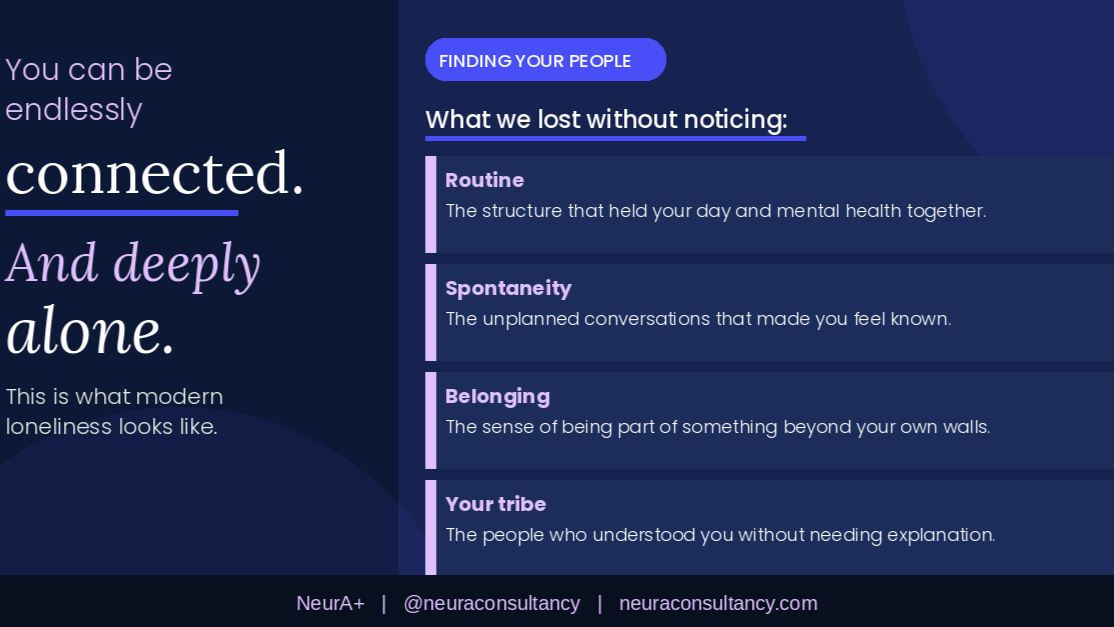
The loneliness most people are living with right now does not look the way we were taught to expect it. This is what it actually looks like. And what genuinely helps.
When most people picture loneliness, they imagine someone physically alone, an empty flat, a quiet weekend with no plans, a phone that never rings.
But that is not what loneliness looks like for most people in 2025.
It looks like a full inbox and a quiet house. It looks like being online all day and genuinely connecting with no one. It looks like scrolling through other people’s lives and feeling more separate with every swipe. It looks like knowing hundreds of people and feeling known by none of them.
This is the shape of modern loneliness. And it is affecting far more people than would ever use that word to describe themselves.
You do not have to be physically alone to feel profoundly isolated, and you do not have to be in crisis to deserve connection.
What working from home quietly took from us
The shift to remote and hybrid working brought real benefits for many people. Flexibility, autonomy, time saved on commuting, these things matter.
But something else happened too, something that got far less attention. The informal architecture of connection that most people depended on without ever realising it simply disappeared.
Not the meetings, not the work, the other stuff. The coffee made for a colleague without being asked, the conversation that started because someone happened to be in the same space, the shared frustration over something small that made two people feel briefly, genuinely understood by one another.
These moments were not inefficiencies. They were the social glue that held people together, and when they went, something went with them that most people are still struggling to name.
Routine collapsed, the structure that quietly scaffolded mental health was gone.
Visibility decreased, being out of sight often meant feeling invisible, both professionally and personally.
Spontaneous connection dried up, and with it, the sense that you belonged to something beyond your own walls.
The tribe disappeared, the people who just understood you, without needing explanation, were no longer a daily presence.
For many people, the result has been a slow, quiet erosion of wellbeing that is hard to pinpoint and harder to admit, because from the outside, everything still looks fine.
The most painful thing about this kind of loneliness is how invisible it is. You are busy. You are functional. You are doing fine, and you are desperately missing a sense of real connection.
The scroll that makes it worse
We were sold social media as connection, and in some ways it delivers. You can follow people you admire, stay in touch with people you care about, discover communities that share your interests.
But there is a significant difference between the experience of being online and the experience of being known, and the more time people spend in one, the more the absence of the other becomes apparent.
Scrolling is passive, it is consuming other people’s curated highlights while sitting alone in a room. It provides the visual and auditory sensation of company without any of the reciprocity, vulnerability or genuine exchange that makes human connection actually nourishing.
For many people, the more time they spend online, the lonelier they feel. Not because social media is uniquely harmful, but because it creates the illusion of connection while quietly substituting for the real thing.
Dating apps, rejection and what they do to self-worth
One of the less discussed aspects of modern loneliness is what happens to people who are looking for a relationship and finding the process genuinely damaging.
Meeting people organically, the way it happened for previous generations, has become harder. Shared spaces, regular community, the kind of slow familiarity that used to develop naturally has become rarer, so people turn to apps.
Apps do facilitate connections, but they also do something else. They turn the experience of meeting people into a volume game, and they attach the outcome to your sense of personal worth in ways that are rarely acknowledged.
When you are rejected by someone you have never met, based on a photograph and a few lines of text, your rational mind knows it is not really about you. But the experience does not always feel rational. Repeated across weeks and months, it accumulates, confidence quietly erodes, the willingness to try again diminishes and the loneliness deepens, even as you are technically doing everything right.
Nobody talks about how much courage it takes to keep showing up in that environment, or how much it costs when the environment keeps not working.
When isolation becomes something more serious
Left unaddressed, loneliness does not stay still, it accumulates and compounds, and over time it begins to affect things that have nothing to do with social life on the surface.
Routine and structure
When work is your only external commitment and home is your only environment, the shape of your days becomes formless, getting started becomes harder, rest becomes less restorative. The boundary between productive time and wasted time blurs and with it, the sense of purpose and momentum that routine quietly provides.
Confidence and self-worth
Without connection, the inner critic has no counterweight, the voice that says you are not good enough, not interesting enough, not worth knowing, has nothing to push back against, it simply gets louder, and louder.
Focus and perspective
When human connection is absent, work often expands to fill the gap. Not out of ambition, but out of need, work becomes the primary source of identity, of structure, of the sense that you are contributing something and when that happens, the pressure it carries becomes unsustainable.
Mental health
Anxiety, low mood and depression are the natural consequences of sustained isolation. Not because there is something wrong with the person experiencing them, but because human beings are genuinely wired for connection, and when that need goes unmet for long enough, the system begins to break down.
Loneliness has the same long-term health impact as smoking fifteen cigarettes a day. It is not a background inconvenience. It is a genuine health risk.
Finding your people. Why it matters and why it is so hard.
People often know they need more connection, they can feel the absence of it. What they struggle with is knowing how to find it, and finding the courage to look, particularly when previous attempts have been disappointing, or the effort of putting yourself out there feels like more than you have.
The challenge is that the conventional advice, join a club, go to events, put yourself out there, assumes a baseline of confidence, energy and social infrastructure that many people simply do not have right now. It is advice designed for people who are already doing reasonably well.
What people who are genuinely isolated often need is something different, a space that comes to them rather than requiring them to go out. A community that is built around shared experience rather than shared geography, a place where the vulnerability of being honest about struggling is the norm, not the exception.
The NeurA+ 5-step process to good mental health
Inside NeurA+, we work with members through a five-step process that addresses not just the symptoms of isolation and poor mental health, but the root patterns underneath them. This is not a quick fix, it is a genuine, structured journey.
Step 1. Understand yourself
Before anything else can change, you need clarity on how your mind actually works. Your triggers, your responses, your nervous system, the patterns you have built over years of experience. Understanding yourself without judgment is where everything else begins.
Step 2. Recognise your patterns
Most of the behaviours that are making your life harder were not chosen. They were learned, built in response to experience, stress, or things that happened before you had the tools to process them differently. Seeing them clearly, and understanding where they came from, begins to reduce their power.
Step 3. Build new strategies
Once you understand your patterns, you can begin replacing the ones that are no longer serving you with approaches that actually fit your mind and your life. Not generic advice. Tools built for how you actually work.
Step 4. Create structure and routine
Structure is not restriction. It is one of the most powerful protective factors for mental health. Simple, sustainable daily frameworks that give your nervous system predictability, your days momentum, and your life a shape that supports rather than drains you.
Step 5. Connect and belong
The final step, and in many ways the most important one, is community. Finding people who understand what you are carrying because they are carrying versions of it too. A space where you do not have to explain yourself from the beginning. Where being honest is welcomed rather than judged. Where you feel, perhaps for the first time in a long time, that you genuinely belong.
NeurA+ is not just a membership site. It is the community that many people have been looking for without knowing it existed.
A final thought
If you recognised yourself anywhere in this article, whether in the quiet of working from home, the exhaustion of dating apps, the way the days blur, the loneliness you would not quite call loneliness, I want to say something directly to you.
You do not have to keep doing this alone………….
Not because there is something wrong with you, but because human beings were genuinely not built for isolation, and the world we are living in has made connection harder than it should be. That is a structural problem, not a personal failing.
NeurA+ exists for people who are ready to stop white-knuckling through it, who are done pretending they are fine. Who want real tools, real community, and a real path toward feeling like themselves again.
Your people are here.
Ready to find your people?
Explore NeurA+ membership at www.neuraconsulting.co.uk
Follow NeurA+ on Instagram @neuraconsultancy for weekly education, support and honest conversation about mental health.