
Burnout is not a productivity problem
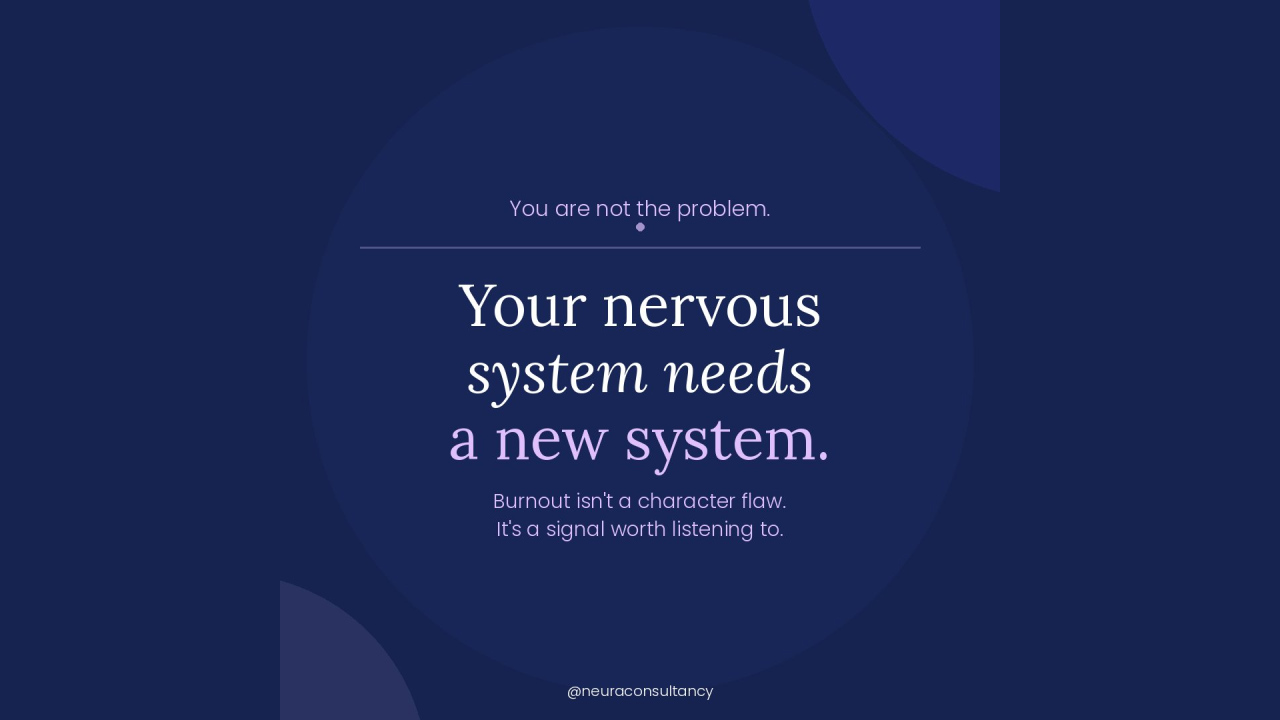
It’s a nervous system crisis. And your body has been trying to tell you.
If you’ve been telling yourself you just need to push through, work harder, sleep better, eat better, or ‘sort yourself out’ — this article is for you.
Because burnout isn’t a character flaw. It isn’t laziness dressed up in a medical-sounding word. It is a measurable, physiological state that affects your heart, your gut, your brain, and your ability to function — and it is far more common in neurodiverse and high-achieving individuals than most people realise.
Burnout is not the price you pay for ambition. It’s a signal your system has been running without adequate support for too long.
What stress actually does to your body
We talk about stress constantly. We wear our busyness like a badge of honour. But very few of us are taught what chronic stress is doing beneath the surface.
When your brain perceives threat — whether that’s a difficult conversation, an overwhelming inbox, or simply a world that feels too loud and too fast — it triggers a cascade of physiological responses:
• Your cortisol levels rise, keeping your heart rate and blood pressure elevated for hours at a time.
• Your gut microbiome is disrupted — affecting digestion, immunity, and crucially, your mood.
• The hippocampus — the part of your brain responsible for memory and emotional regulation — begins to physically shrink under prolonged stress.
For neurodiverse individuals, this response is often amplified. Sensory sensitivities, masking, and navigating systems not designed for your brain means your nervous system is working harder than most people’s, all day, every day.
Burnout in neurodiverse people often isn’t sudden. It’s the accumulation of thousands of tiny over-efforts, finally reaching a tipping point.
Anxiety lives in the body, not just the mind
Anxiety is not simply ‘worrying too much.’ It is a full-body experience that most people learn to suppress, ignore, or push through — until they can’t.
The physical signs are often the first to appear:
• Chest tightness that you’ve normalised as just how you feel.
• Persistent gut tension — IBS, nausea, appetite changes.
• Muscle tension in the shoulders, jaw, and neck that never fully releases.
• A mind that races at 2am when your body is desperate for rest.
Understanding that anxiety has physical roots — and requires physical as well as psychological intervention — changes everything about how we approach it.
The truth about depression — and why SSRIs aren’t the whole answer
This is the section people find most uncomfortable. So let me be clear before I continue: medication saves lives. SSRIs have given countless people the stability they needed to begin healing. This is not an anti-medication argument.
But it is an argument for more.
Depression has biological, psychological, and social roots. It is rarely a simple chemical imbalance that a prescription alone can resolve. Yet millions of people are prescribed SSRIs and sent away without therapy, lifestyle support, community, or follow-up.
• Medication works best alongside therapy — not instead of it.
• Lifestyle factors (sleep, movement, nutrition, connection) have significant, evidence-based impact on depressive symptoms.
• Many people benefit from medication as a bridge — not a destination.
Recovery from depression is not one-size-fits-all. It requires a nuanced, holistic approach — and the space to understand your own story.
ADHD and trauma: understanding the difference matters
ADHD and trauma can look almost identical from the outside — and from the inside. Inattention, emotional dysregulation, impulsivity, difficulty with relationships. Both present in remarkably similar ways.
The difference is critical:
• ADHD is a neurological difference present from early life, consistent across contexts, and often responsive to stimulant medication.
• Trauma is a nervous system adaptation to overwhelming experience, often context-specific, and primarily responsive to trauma-focused therapy.
• Many people live with both — and many are misdiagnosed with one when they have the other.
Understanding which is which — or how they interact — is the beginning of genuinely effective support. It’s also why generic solutions so often fall short.
Your food talks to your brain. Every single day.
The gut-brain axis is one of the most significant and under-discussed factors in mental health. What you eat directly affects your mood, cognitive function, and capacity to regulate your emotions.
The research is clear:
• Omega-3 fatty acids (oily fish, flaxseed) support brain structure and reduce inflammation.
• Fermented foods support the gut microbiome — which produces approximately 90% of your body’s serotonin.
• Refined sugar and ultra-processed foods create inflammation and blood sugar instability that directly affect mood.
• Dehydration — even mild — impairs concentration, memory, and emotional regulation.
This isn’t about clean eating or diet culture. It’s about understanding that the food choices available to us — and the ones we reach for when we’re exhausted — have a measurable impact on how we feel.
Real self-care: the unglamorous habits that actually work
Self-care has been colonised by the wellness industry. It’s become synonymous with bubble baths, face masks, and expensive retreats that most people can’t access — and that don’t address the root cause of exhaustion.
The evidence-based habits that genuinely protect and restore mental health are far less glamorous:
• Sleep consistency — going to bed and waking at the same time daily. Your nervous system thrives on predictability.
• Movement, not exercise — a ten-minute walk counts. Consistency matters more than intensity.
• Boundaries — the word feels overused, but every no to something that drains you is a yes to your own recovery.
• Nervous system regulation — sixty seconds of slow, controlled breathing changes your body chemistry. It is not trivial.
• Human connection — genuine connection, not performative socialising, is one of the most powerful buffers against burnout.
So what now?
If any of this landed with you — if you recognised yourself in the stress response, the anxiety symptoms, the exhaustion that sleep doesn’t fix — I want you to know something important.
You are not broken. You are not weak. You are not failing. You have been running without the right support.
NeurA+ was built for exactly this. For neurodiverse and neurotypical individuals who are burnt out, overwhelmed, and at the end of their rope. A membership platform that provides real tools, real community, and real understanding — for minds that have been underserved by conventional approaches.
We cover stress, anxiety, depression, ADHD, trauma, communication, nutrition, self-care and so much more — with the nuance and depth these topics deserve.
This article has given you a taste. The full picture is waiting for you inside.
Ready to find your people and your path? Explore NeurA+ membership: www.neuraconsulting.co.uk
Follow NeurA+ Consultancy on Instagram @neuraconsultancy for weekly education, support and community.