
Imposter Syndrome
I Sat in Boardrooms Feeling Like a Complete Fraud.
If you’ve ever achieved something significant and immediately thought ‘they’re going to find me out’ — this is for you.
I want to tell you something that most people in leadership positions would never say out loud.
For years, I sat in rooms full of capable, accomplished people and felt like I had no right to be there. I had the title. I had the results. I had the respect of people around me. And underneath all of it, I had a quiet, persistent, exhausting voice telling me it was only a matter of time before they realised I was not who they thought I was.
That is not a confidence issue. That is not imposter syndrome affecting someone who is struggling.
That is imposter syndrome doing what it does best, targeting the people who are succeeding.
Imposter syndrome doesn’t visit people who are failing. It haunts the ones who are achieving and cannot let themselves believe it.
What we get wrong about imposter syndrome
Most people think imposter syndrome is about lacking confidence. It is not. It is about being fundamentally unable to internalise your own achievements, no matter how significant, how consistent, or how publicly recognised they are.
It was first identified in 1978, and research now suggests that up to 70% of people experience it at some point. And yet it remains one of the least discussed realities in professional life, because the people who experience it most acutely are also the ones most skilled at hiding it.
Here is what it actually looks like from the inside:
Every achievement is attributed to luck, timing, or other people, never to your own ability or effort.
Praise feels uncomfortable, undeserved, or even threatening, because it raises the stakes of being found out.
You work significantly harder than necessary to compensate for the fraud you believe yourself to be.
Success brings a moment of relief. Then the fear resets. And the cycle begins again.
That last point is the one nobody warns you about. You think achieving the goal will finally make you feel like you deserve it. It does not. The goalpost simply moves.
Why high achievers are the most vulnerable
There is a painful irony at the heart of this: the harder you work and the more you achieve, the louder imposter syndrome tends to get.
This is because it is not driven by failure. It is driven by the gap between how you appear to others and how you feel inside. The higher you climb, the wider that gap can become. The more people look to you for answers, the more certain you become that they would feel differently if they truly knew you.
For neurodiverse individuals, those living with ADHD, autism, dyslexia, or other neurological differences, this is frequently compounded by years of masking. Of performing a version of yourself that fits the room. Of working twice as hard to appear half as effortless as the people around you.
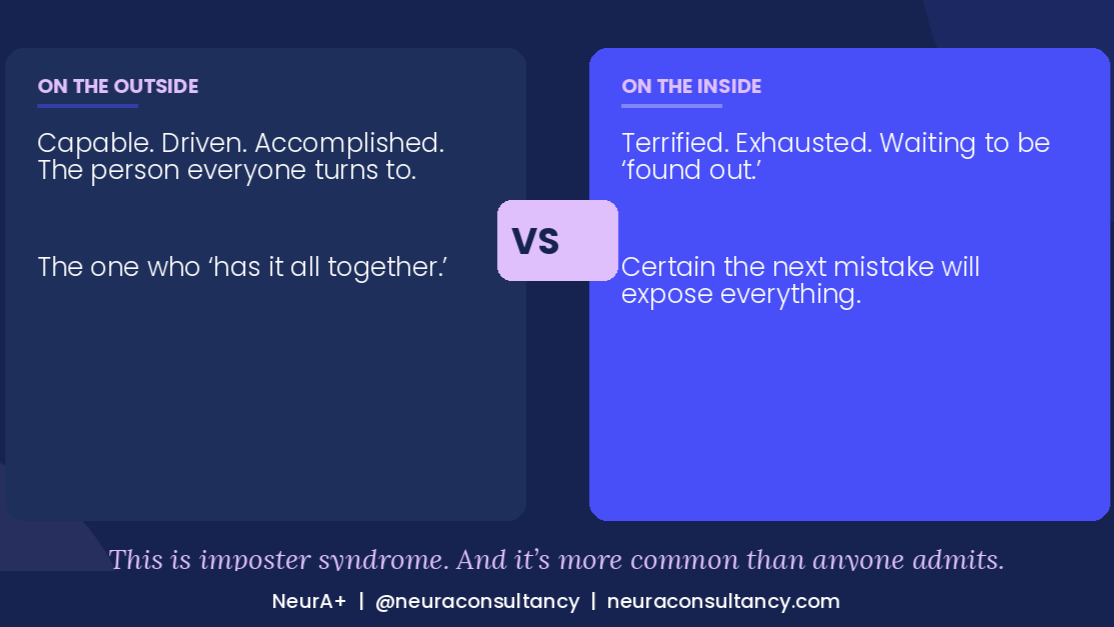
The result is a person who looks, from the outside, like someone who has it all together. And who carries, from the inside, an exhaustion that achievement alone will never touch.
You cannot outachieve a wound. You can only address it.
The achievement myth that keeps people stuck
The most damaging lie imposter syndrome tells is this: ‘Once you achieve X, you will finally feel like you deserve it.’
The promotion. The qualification. The recognition. The salary. Each one promises to be the thing that finally makes it stop. And each one delivers a brief moment of relief, followed by the quiet, creeping return of the exact same feeling.
This is because imposter syndrome is not a competence problem. It is a self-worth problem.
And self-worth cannot be built from the outside in. It cannot be earned through titles or validated through results. Achievements delay the feeling. They do not heal it.
Low self-worth is the deep, often unconscious belief that you are fundamentally not enough, regardless of any evidence to the contrary.
High achievement often becomes the coping strategy for that belief — a way to temporarily silence a voice that resumes the moment the applause stops.
Until the root is genuinely addressed, the cycle continues. The goalpost simply moves.
How it shows up where you least expect it: decision-making
Imposter syndrome does not only affect how you feel. It has measurable, practical consequences on how you lead and make decisions, consequences that are frequently misread as personality traits.
Over-analysis.
Every decision becomes a potential exposure. So you analyse it beyond what is necessary, searching for a certainty that does not exist, because being wrong feels like being found out.
Approval-seeking.
You instinctively know the right answer. But you seek external validation before you will trust it, not because you lack information, but because trusting yourself feels dangerous.
Procrastination.
Not laziness. Fear. If you do not try, you cannot fail. And failure, in the imposter’s internal world, does not mean a setback, it means exposure.
Dismissing instinct.
Your gut tells you something clearly. Imposter syndrome tells you that your gut cannot be trusted. So you override it, and frequently regret it.
These patterns are not character flaws. They are predictable, understandable responses to an underlying psychological experience that, once named and understood, can genuinely be addressed.
What actually helps — and what does not
Let me be clear about what does not help: more achievement. More external validation. Waiting until you feel ready. Telling yourself to ‘just believe in yourself.’
What the evidence and lived experience consistently show works:
Naming it. Understanding what imposter syndrome is and recognising it as a pattern rather than a truth, begins to reduce its power immediately. You are not broken. You are experiencing something known, common, and addressable.
Community. There is something profoundly disorienting, in the best possible way, about hearing other capable, accomplished people describe the exact internal experience you thought only you had. You are not alone. You never were.
Addressing self-worth at the root. Not through affirmations. Through genuine, sustained engagement with the patterns underneath the achieving. This takes time and the right support. But it changes everything.
Learning to receive. Practicing sitting with praise and success rather than immediately deflecting or dismissing it. Allowing evidence to slowly begin updating the internal narrative.
The world has enough spaces that celebrate your output. What you may never have had is a space that supports the person behind it.
A final word — for the person who needs it
If you recognised yourself anywhere in this — in the boardroom feeling, in the relentless work, in the praise that makes you uncomfortable, in the voice that says it is only a matter of time.... I want to say something directly to you.
You are not a fraud.
You are not lucky in a way that cancels out your ability. You are not performing above your station. You are not waiting to be found out.
You are exhausted. From carrying something heavy, often entirely alone, for a very long time.
NeurA+ was built for exactly this. For high achievers who look fine on the outside and are quietly falling apart on the inside. A community and membership platform where this kind of honesty is not just welcomed, it is the starting point.
You do not have to keep performing. You do not have to keep pretending.
There is a different way to live inside the success you have worked so hard for.
Ready to stop performing and start healing? Explore NeurA+ membership at www.neuraconsulting.co.uk
Follow NeurA+ on Instagram @neuraconsultancy for weekly education, support and honest conversation about mental health.